
On Writing The Queer Edge of Space-Time + UK/Europe Release: May 7!
A cover unveil and a few thoughts about writing the cosmos while queer
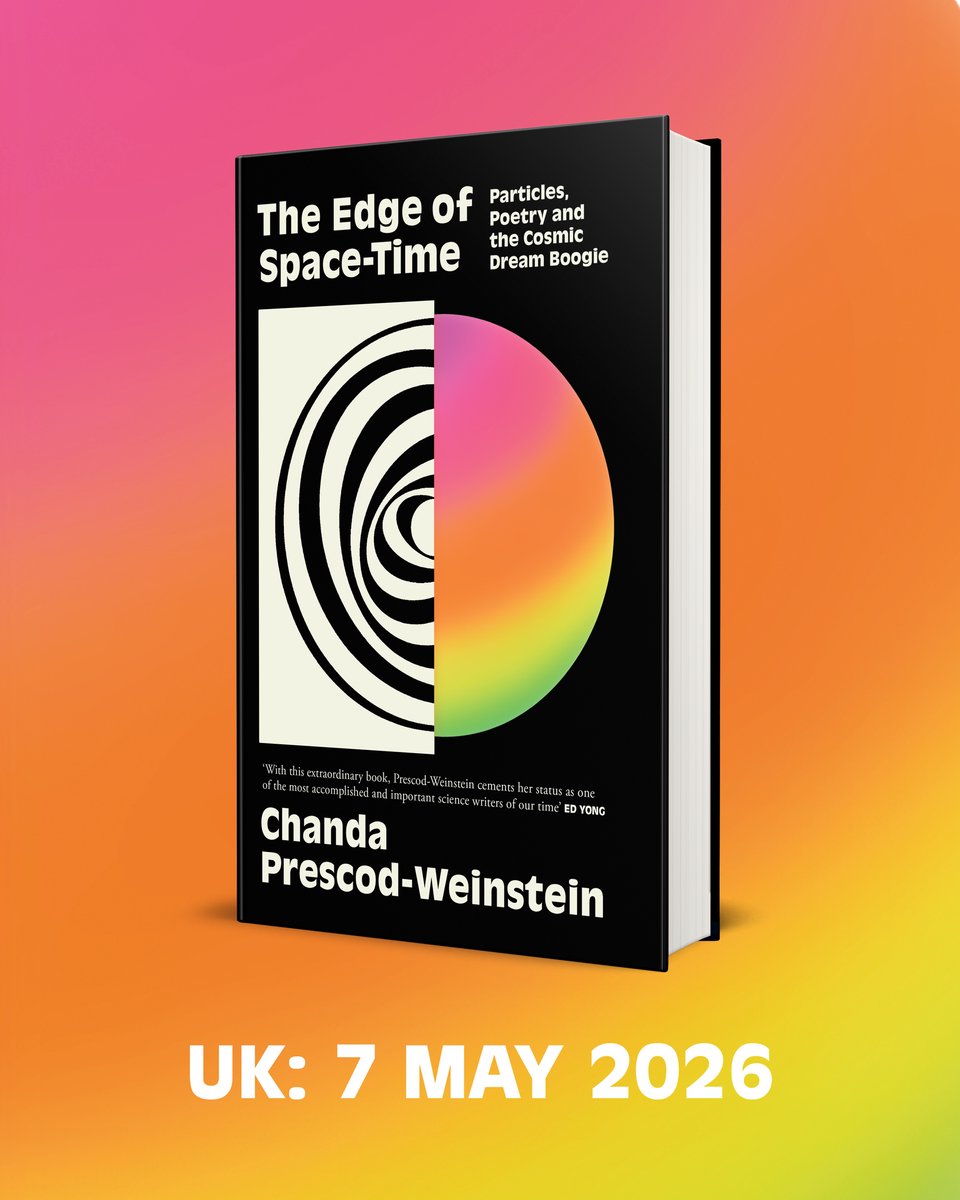
Before I go on a little queer rant, first things first:
Meet the U.K./Europe edition of The Edge of Space-Time, which is now available for preorder and will be arriving from Canongate Books on May 7, 2025! Notice that it’s a different color, it’s got an Ed Yong quote on the front, and the subtitle has lost its Oxford comma! (Canongate house style!) Honestly, I cried when I got Ed’s blurb because Ed is such a phenomenal writer and his endorsement — both of the book and my intellect — really means the world to me. Here is the full quote:
“With this extraordinary book, Prescod-Weinstein cements her status as one of the most accomplished and important science writers of our time; as polymath, griot, teacher, and more; as the guide to the universe that we don’t deserve but absolutely need. She has given us a book about physics as story and metaphor, as revelation and revolution, as answer and antidote. It’s suffused with gorgeous poetry and frequently very, very funny.”
—Ed Yong, author of An Immense World
I hope that motivates you to preorder (UK)/preorder (US)/preorder (Canada)! As I teased a while back on my instagram, we are in a “you’re gonna wanna collect them all” situation with these Edge of Space-Time book covers. And yes, I think North America-based people will be able to get their hands on this beautiful UK-edition pretty easily. (And of course, wherever you are, I am absolutely thrilled for you to get it from your library!)
In other news, The Edge of Space-Time got its first review from Kirkus. On the whole, it’s a very nice write-up that highlights one of my favorite lines from the book, “The universe is too fucking fabulous for capitalism, y’all.” A sample from the review:
“Humanity shines through her writing. One feels a mind present on the page, actively working through ideas, producing a text that’s engaging and alive. For readers put off by the overwhelmingly male, white, heteronormative world of physics, here is a warm, impassioned welcome.” —Kirkus
I will say I objected to one line in it: “One would hope that a physicist advocating a queer perspective would give us the science but tell it slant, but the explanations of the physics itself are for the most part old hat.” Under normal circumstances I wouldn’t (publicly) complain about a critical comment (even if it’s one that would never be made about a straight writer!), but in this case I think it’s simply a false statement, which is worth being clear about.
While the reviewer is entitled to their opinion about whether I did anything well, I think, for one, the invisible enby (non-binary person) would object to being called “old hat” and lacking “queer slant.” Find me another physics book that explains dark matter using a queer cutie like them:
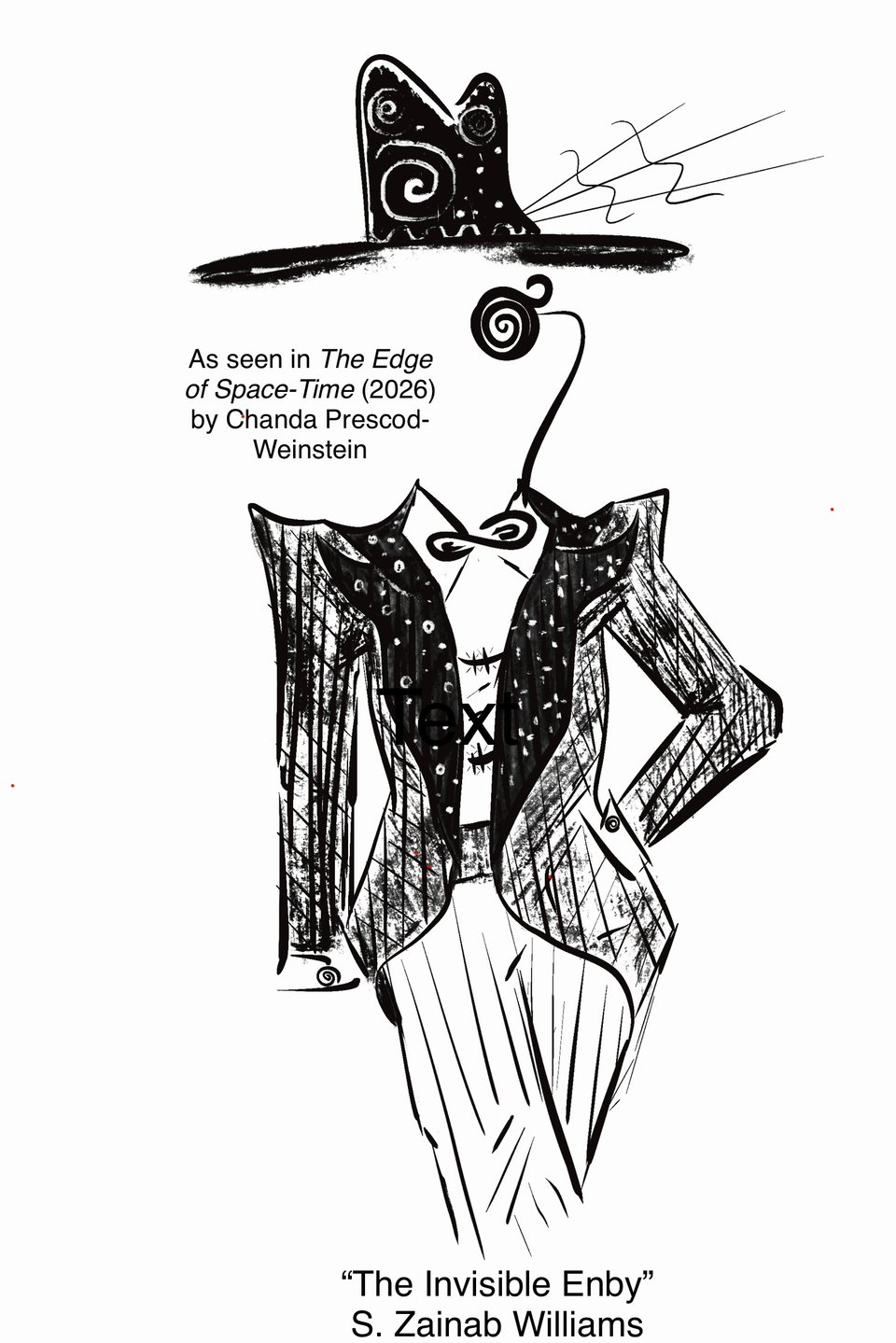
Meanwhile, one thing I loved about writing The Edge of Space-Time was getting to use a gay space love story to help explain quantum gravity. I also had fun using Sara Ahmed’s Queer Phenomenology to explain orienting ourselves in space. Importantly, this book is my attempt to share with the world how the universe looks from the point of view of one Black, queer scientist.
The reviewer’s quip reminded me of a complaint I got a lot about my first book, The Disordered Cosmos. People wanted me to push past the boundaries of what physics is and what physics does to make big claims about Black history like, “The ancient Dogon discovered quantum mechanics.” I can’t honestly make that claim; nor am I tempted to. I don’t need Black history to be more extraordinary than it already is — I don’t have the same sense that Black folks are somehow missing out on having major scientific accomplishments. Similarly, I think the universe is queer by definition because I am in it and because queer stories are one way we interpret our magnificent cosmos. I don’t need to give it a slant. The thing is gay/trans/bisexual, all by itself.
That said, I’m also deeply aware of the way that critics of my work are constantly looking for evidence that I don’t do serious physics and that I am making weird “postmodernist” claims about gender, race, and the universe. As it is, my work calling out racism, sexism, transphobia, and homophobia in physics already means that I regularly hear about the ways I am being excluded from professional opportunities. (Including the day I finished this particular newsletter, actually.) Had I written a book where I made serious academic claims about how actually quantum mechanics makes everything physically gay (or whatever people might be expecting??), I would be attacked by colleagues for doing bad physics. These kinds of worries don’t guide my choices or intellectual commitments, but I do think my readers don’t always realize that they’re complaining that I didn’t commit career suicide.
It may be that the reviewer was looking for something that speaks to the personal in a more direct way, like another book I think you should preorder: Karmela Padavic-Callaghan’s Entangled States, due out May 19, 2026. The book is a memoir that invites the audience into the latest ideas in quantum physics in a way that is deeply personal and wonderfully queer. I liked it so much I blurbed it:
“With Entangled States, Karmela Padavic-Callaghan offers readers an utterly unique journey into the quantum life—one where a love of quantum physics helps a queer immigrant make sense of who they are and make meaning of the cosmos. Come for the analysis of Freddie Mercury’s farewell album, stay for the clear, accessible explanations of next-generation quantum information science. Padavic-Callaghan has written an inspiring book about physics that beautifully centers the importance of being true to yourself.”
—Chanda Prescod-Weinstein, author of The Disordered Cosmos: A Journey into Dark Matter, Spacetime, and Dreams Deferred
As I mention in both my first book and the upcoming one, José Esteban Muñoz’s concept of queerness as futurity teaches us that we are doing queerness when we push the boundaries of what is normal and known outward. As the Vulcans say: Infinite Diversity in Infinite Combinations. That’s queerness. Each of us is gonna do it differently. I hope that all readers — but especially my Black and queer fam — will pick up both of these books and find something useful in them.
Tomorrow, I will be sending the second-pass pages in to my editor, which means that my days of editing this book will be over. The book will be done. But as I learned with the last one, the book becomes something new and interesting independently of me as readers start to engage with it and tell me how it speaks to them. It is an incredibly weird book, but it is my kind of weird, and I hope it’s your kind of weird too!
Remember that preorders make a huge difference in how a book does — especially if you preorder from your local indie bookstore. Even one preorder can determine whether that store orders more and puts it out on their shelves. It can also determine whether the author is invited to do a book tour event in your community (stay tuned for details about my book tour). More than buying a movie ticket, buying a book from your local indie and/or requesting it at the library can transform the life of a book. So please think about doing so, if you can. Thank you!
Before I go: there’s another queer book — by the writer who first introduced me to Muñoz’s book, in fact — that I wanted to mention in this newsletter, but it will have to wait until the next one because their cover reveal hasn’t happened yet. But I am just saying . . . 2026 is gonna be fuckin fire for bi/homo/gender deviant science writing, and I love this for us.
Chanda


