
Our Cosmic Imagination vs. Securitization
The universe is too fucking fabulous for securitization, y'all.
Note: My new book The Edge of Space-Time debuts April 7. Preorders help enormously, and you can get signed and personalized ones here.
Twice a year, Duke University Press has a 50% off sale and I spend hours going through the catalog looking for new and upcoming releases that I should get my hands on. In the last round, I preordered Justin L. Mann’s Breaking the World: Black Insecurity and the Horizons of Speculative Fiction. This book caught my attention not only because of its title but also because the cover uses a NASA space telescope (JWST) image of the Pillars of Creation:
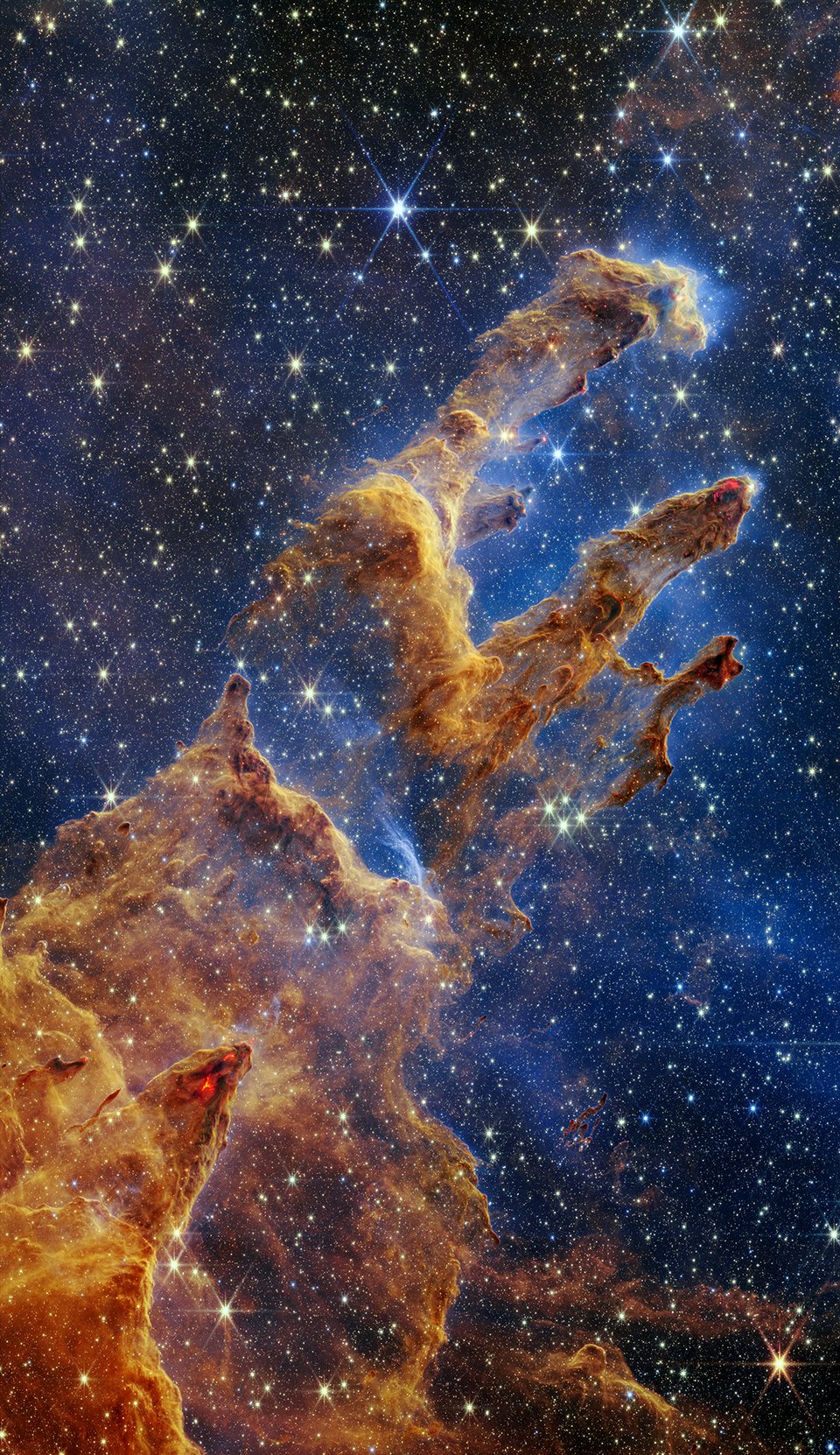
The decision to use this image for the cover caught my attention for a few reasons. One is that the Pillars of Creation are an enormously gorgeous and small, star-forming region inside the Eagle Nebula, which is itself a bright cluster of thousands of stars enveloped in gas. You can see the Pillars poking out in the middle of this image:
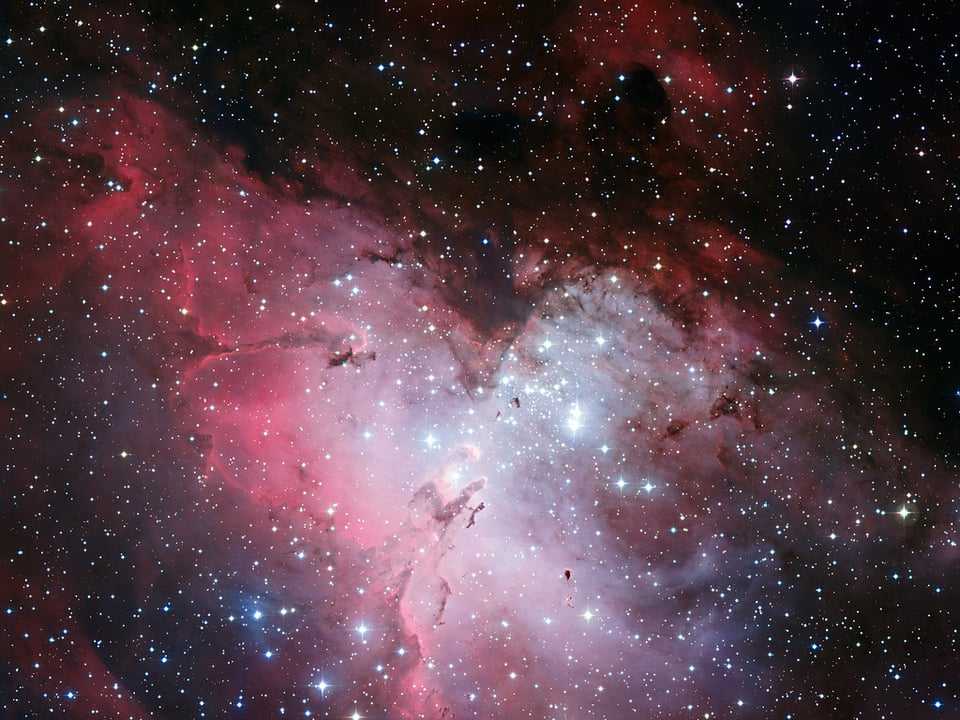
If you’re wondering why the images have different colors, this is a reflection of different wavelengths being observed as well as an artistic choice. Telescope colors have to be added back into the images, and historically, observatories have employed outreach specialists who help make the images accessible to the general public. (These kinds of folks are among those that Trump has fired from NASA.)
Something else I noticed about the Breaking the World cover is the transition away from Hubble Space Telescope images being the main reference point after three decades of dominance over public imagery of deep space. For years, the hallmark image of the Pillars was this one:
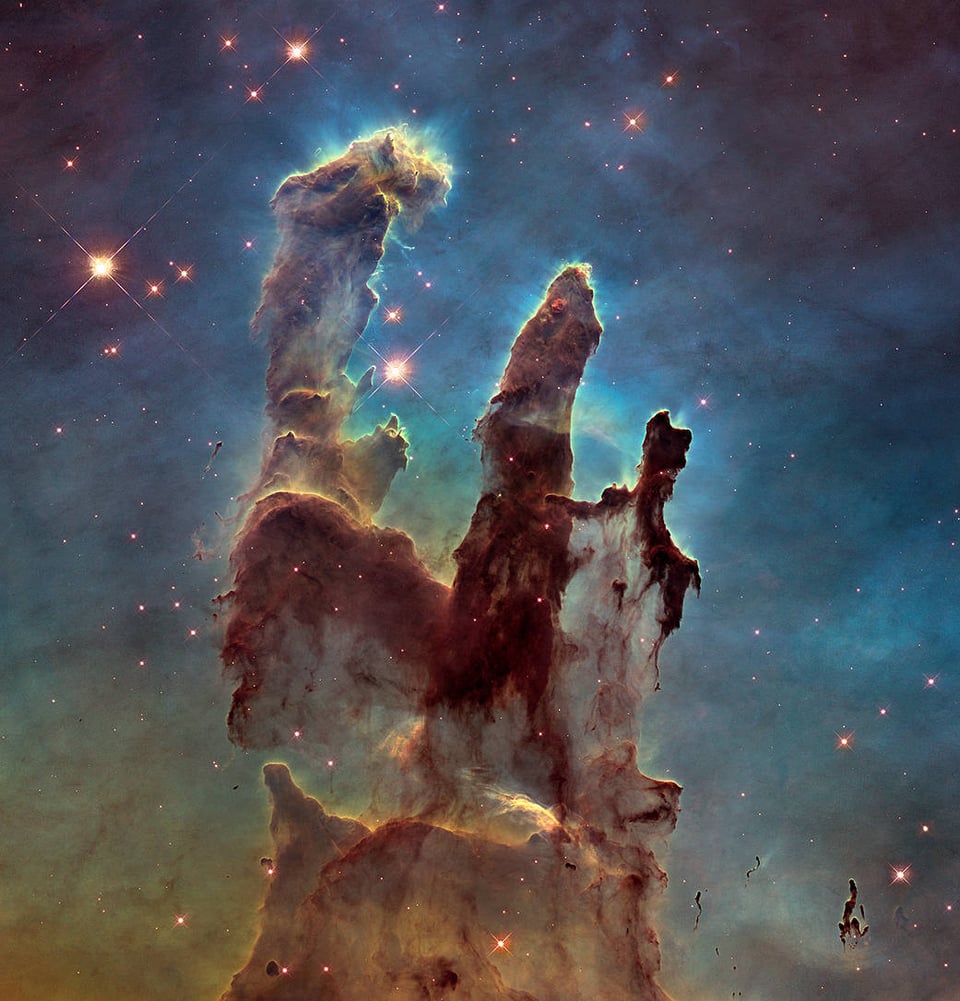
Hubble is primarily an optical and ultraviolet telescope, meaning that it sees in those wavelengths. By contrast, JWST (what I like to call Just Wonderful Space Telescope), is an infrared instrument — and it has a much bigger mirror. So JWST is giving us a more detailed view than Hubble ever could and also it is looking in ways that Hubble couldn’t. The fact that JWST’s image is likely to be defining for a new generation means that they will literally see the universe differently than mine did.
I always pay attention when NASA images get used by members of the public because one of the most incredible things about NASA’s work is that all images produced are public domain. This means that the author and publisher used the JWST image for free, without needing to seek out permission. Anyone on the planet can use NASA images for free, as long as proper credit is given. This is an incredible public service, making visions of the universe freely available.
The perhaps less obvious reason that the book’s cover caught my attention is the juxtaposition of the real image — which I recognized — with the subtitle, “Black Insecurity and the Horizons of Speculative Fiction.” I was interested by the use of real space-time imagery to talk about speculative fiction, especially in relation to Black lifeworlds. I’m especially excited by what links people are finding here because I’m working on a book called The Cosmos is a Black Aesthetic, which is also set to publish at Duke University Press. So, of course, I hit preorder.
My preorder arrived this week, and the opening paragraph is so remarkable that I am sharing it here (you can also read the entire introduction on the Duke University Press website):
This is a book about Black feminist musings about state power, a thinking that happens through speculative projects and imaginaries. It is about the strangeness of fiction and the strangeness of the world securitization has made at the turn of the twenty-first century. Since the 1980s, during which time the American state employed the process of securitization to reorganize society, the economy, and culture, Black people have navigated a dangerous contradiction. In the domestic sphere, the mounting wars on crime and drugs refashioned Black threat as the pinnacle antagonist to late-century domestic tranquility. At the same time, security services—chief among them the military, police, and prison, some of few remaining institutions to receive public funds—offered themselves as vital employment opportunities for Black people (and other people of color) looking to make good on American promises. This contradiction structures the sense and sensibility of Black insecurity, and underlays contemporary notions of security as the most pressing concern for daily life. To bring this evanescent structure into view, I look to what might seem to be a strange source: Black speculative fiction (Black sf). It is precisely the strange sense of disorientation and illogic that makes speculative fiction such an apt genre for understanding Black insecurity. Speculative fiction—including science fiction, fantasy, horror, graphic fiction, and other narrative modes—captures the contradiction of Black insecurity and cracks it open.
In one incredible paragraph, Mann, an English lit scholar and Black studies theorist, describes the descent of American society into a process of securitization, one which is having disastrous consequences under Trump; links it to Jane Austen (Sense and Sensibility); and highlights Black life on both edges of the securitization process. Like honestly, it’s one hell of a paragraph. It made my world make so much sense, and gave me some comfort by giving me a better vocabulary for describing what is happening to my world while also pointing me to people who are offering us alternatives. The decision to package this with one of the most majestic cosmic images that humans have ever seen is a reminder that, as my mom says in the epigraph to my first book, the universe is bigger than the bad things that are happening to us. In The Edge of Space-Time, I declare that the universe is too fucking fabulous for capitalism. It is also too fucking fabulous for securitization, y’all. Our cosmic freedom dreams are a vital response to securitization.
So anyway, I’m very excited to read this book and cite it in The Cosmos is a Black Aesthetic, and perhaps you will be too. Justin L. Mann’s Breaking the World: Black Insecurity and the Horizons of Speculative Fiction is now available wherever you get your books.
My new book The Edge of Space-Time debuts April 7. Preorders help enormously, and you can get signed and personalized ones here.

