
Would you invite a see-through Trojan horse into your home?
I wouldn't! And that's why I don't use technofascist AI.
My new book, The Edge of Space-Time: Particles, Poetry, and the Cosmic Dream Boogie, a national bestseller and finalist for the New England Book Award, is available in North America, UK, and Europe wherever you get your books. I encourage you to shop your local indie, use Bookshop for ebooks, and Libro for audiobooks. There are signed copies of the hardcover at Water Street Books. Another great book that’s in the pipeline about today’s newsletter topic is fellow Black woman scientist Timnit Gebru’s Deep Unlearning, which you should preorder today.

It sounds like a nonsensical proposition. The entire premise of Odysseus’s Trojan horse ruse is that the Trojans don’t know there are enemy Greeks inside. The trick wouldn’t have worked if the horse was transparent, right?
Yet, I’m a physicist watching as my professional community is doing exactly that and supporting the closure of the scientific commons in collaboration with the technofascist creators of large language models, also popularly known as (generative) A.I.
My colleagues are openly welcoming in technologists who are a danger to humanity.
Why am I so convinced that companies like OpenAI, Google, and Anthropic are a danger to us? Because, to paraphrase a David Cross joke, that’s what they fucking said. And I don’t mean their comments about how a super smart A.I. might turn into SkyNet and kill us all. It’s so much more drab than that. The danger is garden-variety fascism, where rich guys ruin everyone’s lives by deskilling workers, suppressing wages, and concentrating wealth in the hands of a few oligarchs. Or what the dudebro technologists like to call “disruption.” Those same dudebros, which Adam Becker has been known to call AI Overlords and Gil Durán has called the Nerd Reich, are the oligarchs! Surprise!
Becker says they’re on a “crusade to control the fate of humanity.” (That’s literally part of the subtitle of his book, More Everything Forever: AI Overlords, Space Empires, and Silicon Valley’s Crusade to Control the Fate of Humanity.) Durán’s book is centered on a little-known anti-democracy book from the 1990s, The Sovereign Individual: How to Survive and Thrive During the Collapse of the Welfare State, which ended up being a major influence on Peter Thiel. You might be familiar with Thiel because he is (Catholic) Vice President J.D. Vance’s most important financial backer. Or because he’s been giving some very weird lectures about the Antichrist, where he says that tech critical people are just like the Devil (???). Thiel is leading a cadre of technofascist oligarchs who believe that they should control the world and technology is the means to do it.
Note that I said these technologists are a danger, not the technology. Because technology is a social choice, not a physical inevitability (as Brian Merchant has emphasized). This is a basic lesson of the academic field of Science, Technology, and Society Studies, which investigates science and technology in social context, rather than treating them as though they somehow happen outside of society without humans. (Though as Becker, and Karen Hao emphasize, the Nerd Reich are kind of hoping that somehow it can be done with minimally humanized humans.) This way of seeing things helps us understand: It is up to us whether we hand Thiel and the rest of his see-through horse brigade the keys to our intellectual homes.
Meanwhile, as Emily Bender and Alex Hanna point out, “A.I.” is a name that artificially hypes a variety of pattern-matching technologies to make them sound more human-adjacent than they are. The name “A.I.” is a con!
As a member of the Association for Human Mathematics, I’ve found it useful to think with Bender and Hanna’s breakdown of what is really happening when “A.I.” is doing things (p. 6). They name five types of automation that are being used in various ways:
Decision making. Machines are being used (by people) to make important decisions, like deciding which résumé would actually be looked at by a human.
Classification. Think about when you search your smart phone images app for all your pictures of the sky. Some algorithm has classified the images.
Recommendation. This uses prior information and a series of assumptions to make suggestions to someone. Think about when Amazon recommends a book to you.
Transcription/translation. We’ve all used Google translate. I occasionally do it when I want to check whether I’ve made an embarrassing grammatical error while writing in Dutch.
Text and image generation. This is often popularly known as Generative AI. The “generative” part is apt in the sense that it makes shit up. It’s not so apt when you consider that all it can do is remix things that were fed into it — other people’s writings, drawings, music, or if we’re deeply unlucky, another GenAI’s slop.
Some of these tools can be useful, especially if algorithms with well-understood limitations are: designed to do one thing and do it well (instead of everything machines), designed with data rights as human rights at their core (which means not stealing from artists!!!!), and designed so people have a choice in whether they are subject to automation (see Bender and Hanna p. 189 for more on this). I’m thinking about how in astrophysics and cosmology we use machine learning algorithms to help us look for weak gravitational lensing, which is hard to spot with the naked eye and more readily detected by looking for statistical correlations. But before the government tagged funding to calling these machine learning algorithms “A.I.,” we were quite happy to call them “machine learning” and go about our daily lives. (Though I always worried about how our machine learning innovations might be adapted for more nefarious uses and have not contributed to them myself.)
Bender and Hanna point out that these five kinds of automation are actually all different types of technologies (algorithms) that are being lumped together under the name “A.I.” because it “creates the illusion of ‘intelligent’ technology,” when actually it’s not smart. Swirling statistics and automation are not “thinking,” but rather processes that often rely on stealing human work, remixing it, and presenting it as something innovative. You might feel like an artist because you typed a prompt and you got a picture on the other end. But you’re not. You’re someone who refuses to pay for skilled labor but feels entitled to its work product anyway. Bender sees this false belief in the intelligence of A.I. from her point of view as a linguist: It is rooted in how humans conflate “uses language” with “must be very smart.” (Yet, Apartheid Clyde uses language and ????) Calling these synthetic, statistical algorithms “intelligence” becomes a kind of mystification that makes it harder to criticize and resist harmful uses of them.
Importantly, Bender and Hanna say, “‘AI’ has always been a marketing term.” Yes, folks, you’re being sold propaganda. A bottle of snake oil. A bridge to nowhere good.
They’re marketing all sorts of things to us, the promise of better science, of having skills without doing any learning, of making money without having to pay anyone for their labor. Even the way they keep saying SkyNet-like A.I. might destroy humanity is a marketing ploy to make us think it’s capable of things that it’s not — and to evade the fact that technofascists are the danger, not some lines of code.
Why market to us like this?
Lately, I’ve been thinking a lot about this page from Hari Kunzru’s 2020 novel Red Pill, which is about a guy who can see the 2016 electoral shit show and its aftermath coming, and isn’t handling it so well.
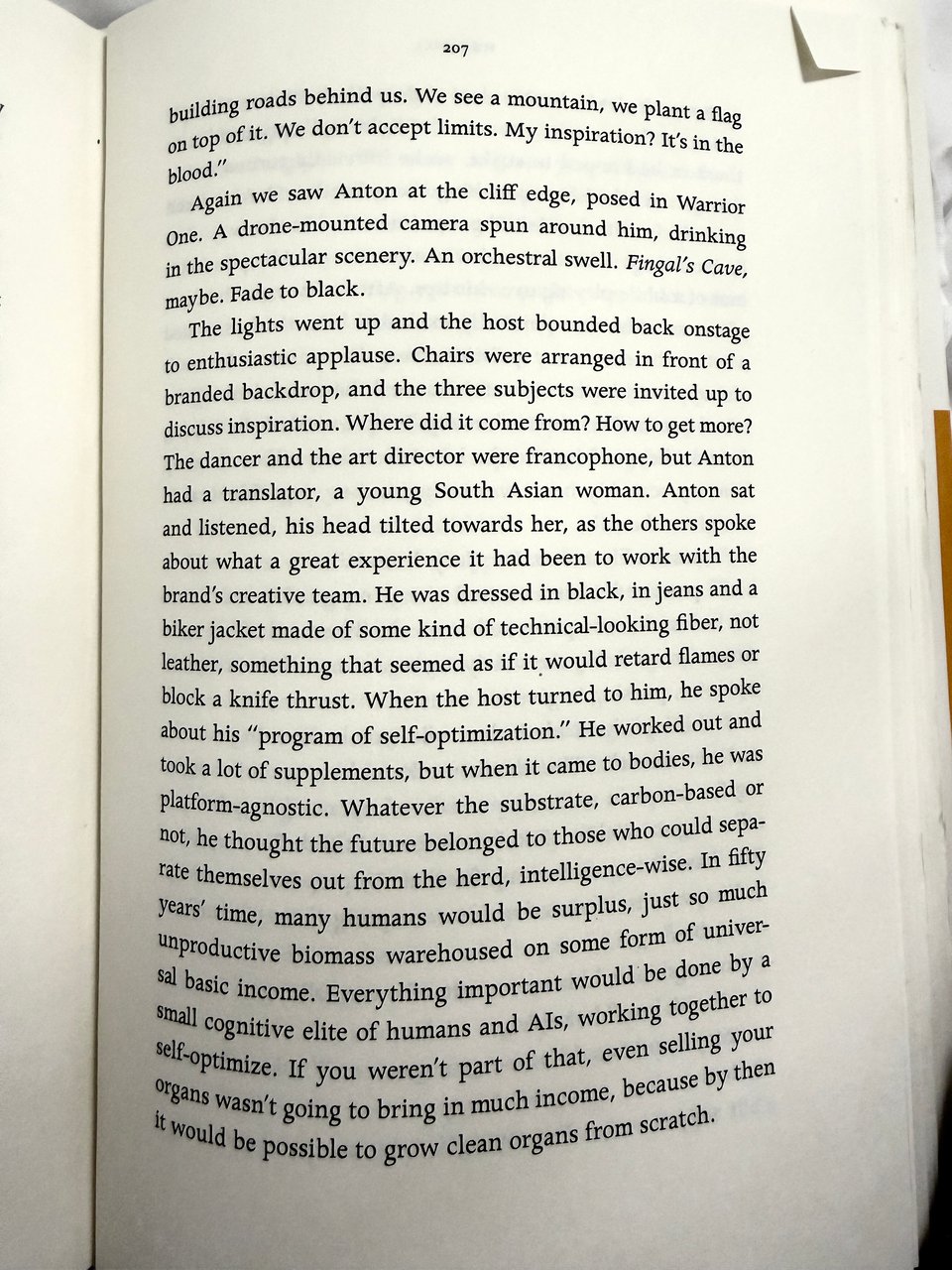
The scene is a hack filmmaker who is making predictions about the future after premiering a short film with white nationalist undertones. And the part that really stuck with me was this:
Whatever the substrate, carbon-based or not, he thought the future belonged to those who could separate themselves out from the herd, intelligence-wise. In fifty years time, many humans would be surplus, just so much unproductive biomass warehoused on some form of universal basic income. Everything important would be done by a small cognitive elite of humans and Als, working together to self-optimize. If vou weren't part of that, even selling your organs wasn't going to bring in much income, because by then it would be possible to grow clean organs from scratch.
The question isn’t whether this vision of the future is especially realistic (it’s not), but rather that people with way too much power, money, and time on their hands believe this kind of stuff (religiously, Rabbi Greg Epstein argues). And yes, I’m thinking about the venture capitalist who wants to buy a galaxy. (And people keep trusting that guy with money???) We are talking about eugenicists with a gods complex.
They believe their hype — at least in some cases — but most importantly, they need us to believe their hype. They need us to believe in what Merchant calls deterministic futurity (p. 405), the idea that our world will be rebuilt by these new automation systems and that it’s not possible to oppose them. They want us to just accept that this is an important new way to do genocide and war (crimes) and that those things are inevitable too. They want us to accept the racism that Joy Buolamwini and others have shown is baked into the tech, which from a white supremacist point of view isn’t a flaw but rather a feature.
And, as Merchant says, “Bosses may not be able to automate away all of their workers, even if they’d like to, but they can deskill them, slash their benefits and protections, and reduce their wages.” Even if the technofascists can’t regrow organs, they can at least create the conditions where we have no choice but to sell ours. Or, in the case of a full return to an enslavement economy, we might have to live through our organs being stolen from us by people like George Washington, who took the teeth of enslaved people right out of their mouths.
So this brings me back to the question of whether you’d invite a see-through Trojan horse into your home. Knowing all of this, why would you invite ChatGPT, Gemini, Claude, Muse, and AI search engine results into your home? Why would you give them money? Or any information about you? And if you’re a professional physicist or mathematician, why in the ever-living fuck would you collaborate with them?

