
An Odyssey Through Testimonial Injustice
On reading Dr. Emily Wilson, properly
My book, The Edge of Space-Time: Particles, Poetry, and the Cosmic Dream Boogie, is now available in North America, UK, and Europe wherever you get your hardcovers, ebooks, and audiobooks. I encourage you to shop your local indie, use Bookshop for ebooks, and Libro for audiobooks. There are signed copies of the hardcover at Water Street Books. Loyalty Books has signed book plates for both Edge and The Disordered Cosmos while supplies last.
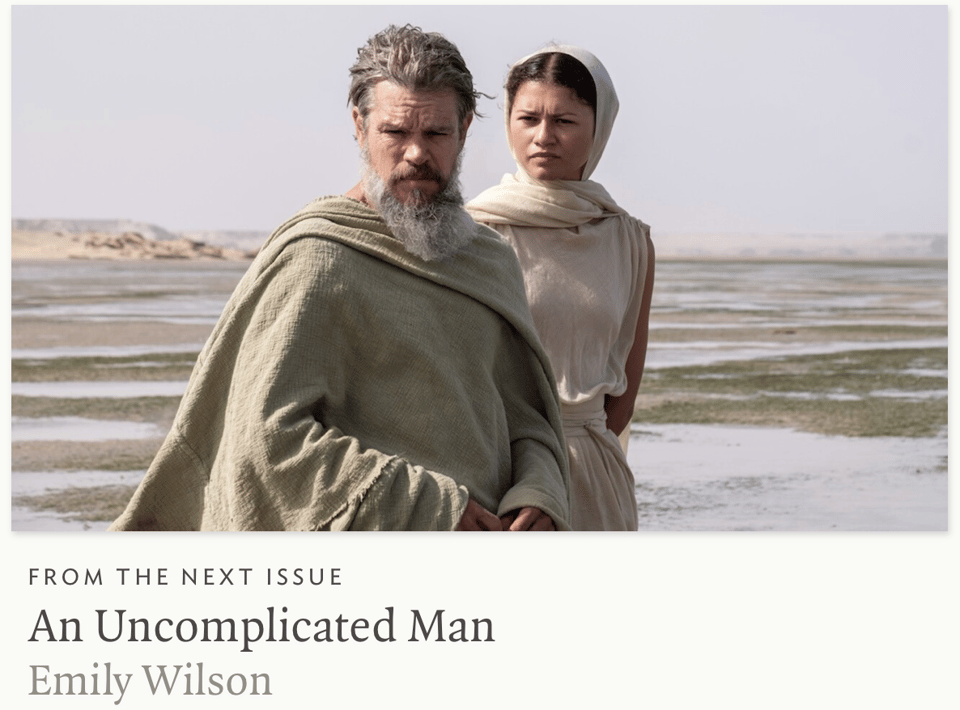
When Emily Wilson’s translation of The Odyssey first came out in 2017, I went to my local bookstore and bought it in hardcover. Like many Americans, I had never been required to read Homer at any point in my education. Like many feminists, I was intrigued by what a feminist translation had to offer. By that time, I had already grabbed a copy of Caroline Alexander’s translation of The Iliad, initially because I’m a Trekkie and Enterprise’s Dominic Keating served as the audiobook narrator.
The books sat on my shelf for years. I started The Iliad but didn’t have a sense of why I was there, much as I like Dominic as a performer. Then Christopher Nolan announced his adaptation of The Odyssey and I knew I’d finally have to get around to it. By then, I had started Wilson’s since published translation of The Iliad multiple times but struggled to give it the full attention it demands. At least, I had begun to understand that given my own sensibilities about completeness, the books should be read as a pair, with The Odyssey coming second.
In the end, I crammed like I was reading the books as a student. I read Wilson’s Iliad in a weekend. I don’t especially recommend this — it’s a long poem, there’s a lot to take in, and my brain felt like it was going to explode at the end. It did help that I read immersively, following along on the page as Audra McDonald narrated. It was an eye-opening experience; in a weekend, I came to understand that every single character in one of the most influential works of the western world was . . . a complete asshole. I realized that men in colonial societies had read this book as a foundational text — had modeled themselves on its expressed ideals. A lot of things started to make sense, thanks to Wilson’s able translation, wonderful introductory materials and extensive endnotes.
I began her Odyssey that Monday. I went in so certain that I would be as engaged, though less certain I would enjoy the narration from Claire Danes. Danes turned out to be alright. The translation, for me, less so. I found it clunky and at times a bit too cute. I eventually gave up at Book 5, line 339:
“Poor man! Why does enraged Poseidon
create an odyssey of pain for you?”
I knew the word in the text could not be “odyssey.” And I felt that the decision to use the word here was a distraction. I spent hours down a rabbit hole, reading the Greek, looking up the words in a dictionary, and comparing this translation with others. I understand why Wilson chose the word and its connection with a verb that appears in the original Greek. The problem is that “odyssey” is for the casual English reader a synonym for “journey,” and that simply doesn’t capture the meaning and nuance of the Greek original.
There were a few moments like this one, when I wondered where the poetry in the text had gone. I had never asked myself this while reading The Iliad. I concluded that Wilson was still honing her poetic voice with The Odyssey and this wasn’t how I wanted to make a journey that I planned to finish over three days. So I quit that translation and moved on (to the Daniel Mendelsohn, for anyone who is curious).
I am grateful to Wilson though because without her, I might not have finally gotten around to starting and finishing these culturally significant and very rich texts. Her introductory material and translator’s notes helped set me up for a deeper understanding of this literature than I otherwise would have had, even though I chafed — a lot — at her discussion of why she used the terms “house boy” and “house girl” when discussing enslaved servants in The Odyssey. (I simply don’t think evoking Atlantic chattel slavery does the work Wilson thinks it does, at least not for me as a descendant of people who suffered through that horror.)
I also have to be grateful to Wilson because Christopher Nolan himself has cited her translation as a key motivator for his decision to adapt the film. And the film, whatever we may think of the filmmaker’s choices, has successfully gotten people to go to the movies, which I love. And more importantly, it’s gotten people to read texts that are layered and challenging and to engage in the practice of collective critical analysis about a text’s meaning. At a time when reading in long form seems to be in trouble, I cannot complain about that.
I had planned, at some point, to write a newsletter about this journey and about my thoughts on the film. But Emily Wilson herself wrote a lot of what I might want to say about the film, and I found myself wanting to address the absolutely bizarre social media reaction to a woman expert daring to have critical opinion of a popular man’s work in public.
Wilson’s review of Nolan’s film in the London Review of Books (LRB) pulls no punches. In the first paragraph, she says:
Unlike some of Nolan’s other films, The Odyssey is not boring, thanks to the source material, which is impossible to mess up entirely.
Tone set. For those who aren’t familiar with LRB, which I have been a subscriber to for 23 years, this is a place where every review is over 4000 words and takes the form of an expert analysis. LRB essays are never just about the text being discussed — they are also situating the text in expert context. And whatever one might think about Wilson’s poetics, few people are better situated to discuss The Odyssey-the-film’s relationship to The Odyssey-by-Homer. Wilson, whose translation was a major cultural event and controversy (due to the feminist angle) long before Nolan ever mentioned it in interviews, has undergraduate and postgraduate degrees in the classics and is a tenured professor in the subject. Which is a longwinded way of saying Emily Wilson knows her shit.
And she didn’t love how Nolan adapted the story to film.
That’s not a problem, unless you’re a certain kind of dude on the internet. I’ve seen more than one man remark — in one case directly to me — that Wilson should be grateful to Nolan that he’s helping her sell books and not bite the hand that feeds her. As if she needs Christopher Nolan to make the case for her work. As if she — a third generation academic and second generation Oxbridgian — studies and writes about Ancient Greek literature for the money and fame.
The other complaint I’ve seen is that while Wilson knows literature, she doesn’t know film. There are a few reasons this is silly. The first is that I am fairly certain that no one who has made this comment has pulled Wilson’s CV to investigate her experience with teaching and critically analyzing film adaptations. This assumption about her depth of knowledge with film is a big “ass” “u” and “me” moment for the ones saying these things. One reason I’m confident they haven’t done this is because I looked for her CV, and it’s not publicly available. From my perspective as someone who researches the intersection of identity and knowledge production, this is a clear case of bias: people are assuming based on her identity — and I do think it’s because she’s a her — that she can’t possibly hold sufficient expertise to criticize a film.
The other thing that’s silly about complaining about a book expert writing a review in a publication called the London Review of Books is that this is a publication that explicitly looks to situate narrative forms in their contextual relation with books. Which is to say, my dudes, it’s in the title.
But perhaps most importantly, we don’t go to Wilson because she’s an expert on film. We go to Wilson because she is an expert on The Odyssey and the various forms it has taken both on the page and in the popular imagination. How do we know? Because she published a fucking book about it — a translation of The Odyssey with the most extensive introduction and notes available among all the English-language translations. In those essays and editorial notes, Wilson discusses The Odyssey as a significant cultural phenomenon, one that Nolan is now contributing to. Of course, she is a quite natural person to commentate on what narrative work the film does in context of the culture that it is entering. Wilson, more than most people, has extensive experience with adapting The Odyssey and experiencing public reaction to it.
In my view, what is happening with this public treatment of Emily Wilson having an opinion is an example of what philosopher Miranda Fricker calls testimonial injustice. Testimonial injustice is the phenomenon where a knowledge holder’s expertise is diminished or ignored because of assumptions about the quality of their knowledge in connection with their identity.
When men say she should be grateful for the attention, they’re saying a woman’s scholarship only gains true meaning when a famous man shines a light on it. When they say she doesn’t know film, their confidence about their assumption is in conversation with a broader misogynist culture where women’s knowledge is always at a deficit. We have to work harder to prove that we too can know things and be highly competent. And when they dismiss her critique simply because film criticism isn’t her major area of work, they are dispensing with testimony that can deepen our understanding of the relationship between films and the books they adapt and what happens to narrative in the process of translation.
So anyway, maybe it’s not surprising that people are behaving like this, but it is kind of a bummer. I don’t think one has to agree with Wilson’s point of view to recognize that she is entitled to have it and knows more about the film’s source material than the rest of us do. Sure, if this were an article in American Cinematographer (where I am also a subscriber), I’d be concerned about why she of all people was asked to assess the (brilliant!) cinematography and the (questionable, maybe) choice to film exclusively in 70mm IMAX. But that’s not what LRB asked of her, and that’s not what she did. Instead, she offered a perspective on Homer’s Odyssey that will help viewers understand the distance between Nolan’s choices and one of his textual foundations. Reading Wilson is an opportunity to learn at the feet of an expert, even if we don’t always agree with the conclusions.
7/28/26 edit: Fixed a typo (chapter became book) and removed the first mention of “testimonial injustice.”

