
You should go see Supergirl
It's pop art that is unapologetically political.
My book, The Edge of Space-Time: Particles, Poetry, and the Cosmic Dream Boogie, is now available in North America, UK, and Europe wherever you get your hardcovers, ebooks, and audiobooks. I encourage you to shop your local indie, use Bookshop for ebooks, and Libro for audiobooks. There are signed copies of the hardcover at Water Street Books and Harvard Books, which is also the only bookstore in the world that has signed paperbacks of The Disordered Cosmos. Loyalty Books has signed book plates for both books while supplies last.
[Trigger warning: mentions of various types of violence against women.]
If you’re pissed off that the United States is currently run by brazen misogynists who are suspiciously adjacent to pedophilic sex trafficking rings, you should go see Supergirl. If you’re a survivor of sexual assault or domestic violence, you may find the film especially satisfying. And if you were wondering whether the James Gunn DCU would extend the discourse about Palestine from last year’s Superman, then you’ll want to at least watch (anti-Zionist Jew and child of Holocaust survivors) David Krumholtz’s performance as Zor-El, Supergirl’s father.
By now you may have heard that the new Supergirl film has received mediocre reviews and has had disappointing box office returns — making over $100 million less on opening weekend than Superman (2025). I went and saw the film twice this past weekend — two IMAX matinees — and I noticed that the theaters were disproportionately full of men. Maybe that was just where I saw the movie and the time I chose, but it worries me that women aren’t going to see this movie because this film is about a woman refugee dealing with trauma, isolation, and grief. It is also about orphans, found family, the immigrant experience, and young women coming into their power.
Supergirl is about what happens when a young woman realizes that her life matters and that she is but one life, but in community, her life can hold meaning and impact. It is about letting go of expecting that we can have the perfect trajectory — and respond perfectly — in a world where bad things happen and systemic misogyny governs so much about our lives. And MILD SPOILER ALERT, it is about beating the shit out of incels.
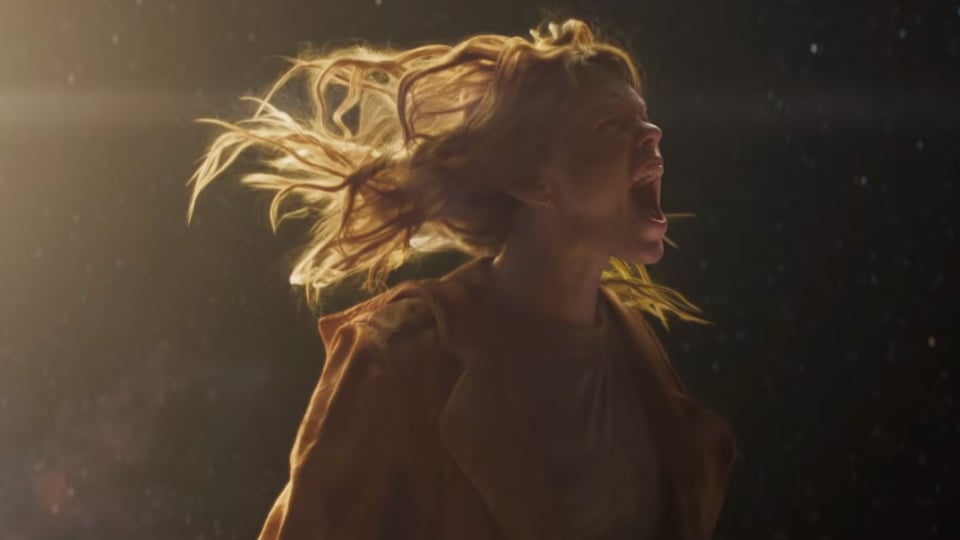
If you’ve read my first book The Disordered Cosmos, then you know that when I was around the age Kara is in this film, I was raped. And in context of that experience, I found this movie very satisfying. I found it satisfying when Kara flew into space to scream at the top of her lungs because of all the trauma and injustice she had witnessed — as someone posted on Threads, that’s anyone who is conscious of this political moment right now.
And I thought she gave us all good advice when she said, “Your life will be your revenge.” And I found it satisfying when she kicked the shit out of sex trafficking incels to a soundtrack that reflects the range of women’s emotions and musical commitments.
A friend was surprised by my reaction to this film because he thought I might have difficulty identifying with a blonde blue-eyed white woman. First of all, I am troubled by whiteness as a political system and power structure, not fundamentally by individuals whose embodiment is favored by that system. I thought Milly Alcock was great as Kara, and in the first third, her state of mind reminded me a lot of how I reacted to my assault, including the drinking and lack of care for my physical well-being. I also thought it was useful to use a a woman who fits the white supremacist archetype of beautiful to challenge dominant narratives about what refugees go through. She should not be the end of the conversation, but I don’t mind her being a part of it. I don’t think women of color characters should be the only ones to be asked to carry the burden of telling those stories.
It’s also the case that during my first viewing of the film, I thought a lot about Gene Roddenberry’s idea that Star Trek would be a space western, and how much this rendering of Supergirl — which is based on the comic Supergirl: Woman of Tomorrow — reminded me of the first Black woman character to helm a Trek series, Michael Burnham. Like Kara, Burnham is something of an orphan. And like Supergirl, Star Trek: Discovery received a cold reception from fan boys who were pissed off to see a woman at the center of a story, especially one who was working through trauma, trying to find her place in the universe, and sometimes making mistakes along the way.
Are women allowed to be damaged? To have ugly moments? It took me many years to make peace with Burnham’s mistakes at the beginning of Discovery Season One. I wanted her to be an example of Black women being amazing. But what a burden I was putting on her — and myself in the process. Eventually I realized that part of the story the writer’s room chose to tell was one where a Black woman comes into her power — in a universe where her race and gender don’t govern how her imperfections are analyzed. It’s tricky to do that kind of science fictional work for an audience and a world where the character’s race and gender will determine so much about how she is received. But it is nonetheless important to imagine other worlds, ones where that isn’t a problem.
Unlike Trek, Supergirl doesn’t use futurism as a vehicle and instead focuses intensely on a universe that parallels ours: the misogynists are in charge, they are powerful, and they are ruthless. And we are not perfect heroes. But however damaged we may be, Supergirl posits, we can be heroes. And we can cry, and scream, and mourn, and do it girly, do it rough, do it however we need to do it, as long as we remember the value that we help those in need.
I think of Supergirl as part of a trilogy with last year’s Sorry, Baby and this year’s Is God Is. They’re all very different films, but they all grapple with what it means to embrace life under the totalitarian horror of misogynist violence. Sorry, Baby is about an incident similar to what happened to me, a sexual assault of a graduate student by a trusted academic mentor. I loved this film. It is not romantic about what recovery looks like. But it does say that we survivors show up for those who come after us, and it says we can find meaning in the life we live afterward, even with all of the horrible memories we carry within us.
Is God Is is about the legacy of domestic violence in a Black family and the question of what revenge does or does not do for us. I thought it was brilliant, and even though it was a bad sign that we were the only ones in the theater when I saw it, I am glad for that because how I cried and howled at the end. It unleashed a lot of emotions I had about men who are offered redemption and refuse to accept the olive branch. I think it offers a similar perspective on revenge as Supergirl, which is that revenge takes something from the person enacting it. I happen to agree with this. Is God Is elicited a lot of strong reactions because some viewers thought the film was condemning Black women’s anger. But I think it was asking the question of when/how translating that anger to violence serves our potential for finding peace. Supergirl is a meditation on this same question, with an Asian British girl at its center, and it answers in a rather complex way. If I had to venture a guess, I’d say the authors of both films — Aleshea Harris (also the playwright and director behind Is God Is) and Ana Noguiera — were both thinking deeply with Japanese filmmaker Akira Kurosawa’s career-long exploration of revenge as a theme.
Sorry, Baby and Is God Is are both independent films that didn’t spend much time in theaters. Supergirl is of course the opposite, a major intellectual property vehicle intended to make money. But I think it is a reminder of what political choices the creators behind pop art can make — and the Ana Noguiera-penned screenplay is a beautiful homage to what DC and Marvel Comics do when they’re at their best: criticize what is broken about the world and motivate us to build one where everyone’s needs are taken care of.
Anyway, I’m not surprised that film reviews have been hard on the film, and it’s clear that a lot of men didn’t understand who the villain in Supergirl was. (Beware the guy who thinks an incel isn’t a very bad villain, by the way.) And I am worried that if people don’t buy tickets for this movie, we won’t get another one that is this curious about the inner worlds of girls and women.
If you got this far into this piece, thanks. And please watch these three films: Sorry, Baby; Is God Is; and yes, the comic book superhero film Supergirl.

