
The Poetics of Science
What "The Kraken" teaches us about the relationship between science and poetry
My new book, The Edge of Space-Time: Particles, Poetry, and the Cosmic Dream Boogie, a finalist for the New England Book Award, is available in North America, UK, and Europe wherever you get your books. I encourage you to shop your local indie, use Bookshop for ebooks, and Libro for audiobooks. There are signed copies of the hardcover at Water Street Books.
Last month I went on vacation, which largely means I went to a Star Trek convention and read books for fun, instead of for work. One of those books was The Boundless Deep: Young Tennyson, Science, and the Crisis of Belief by Richard Holmes. A biography of the early years of poet Alfred Tennyson, it focuses on how science influenced the man who would go on to become Queen Victoria’s poet laureate. Since I’ve just published my own book about the power of poetics within and around science of course the book caught my attention.
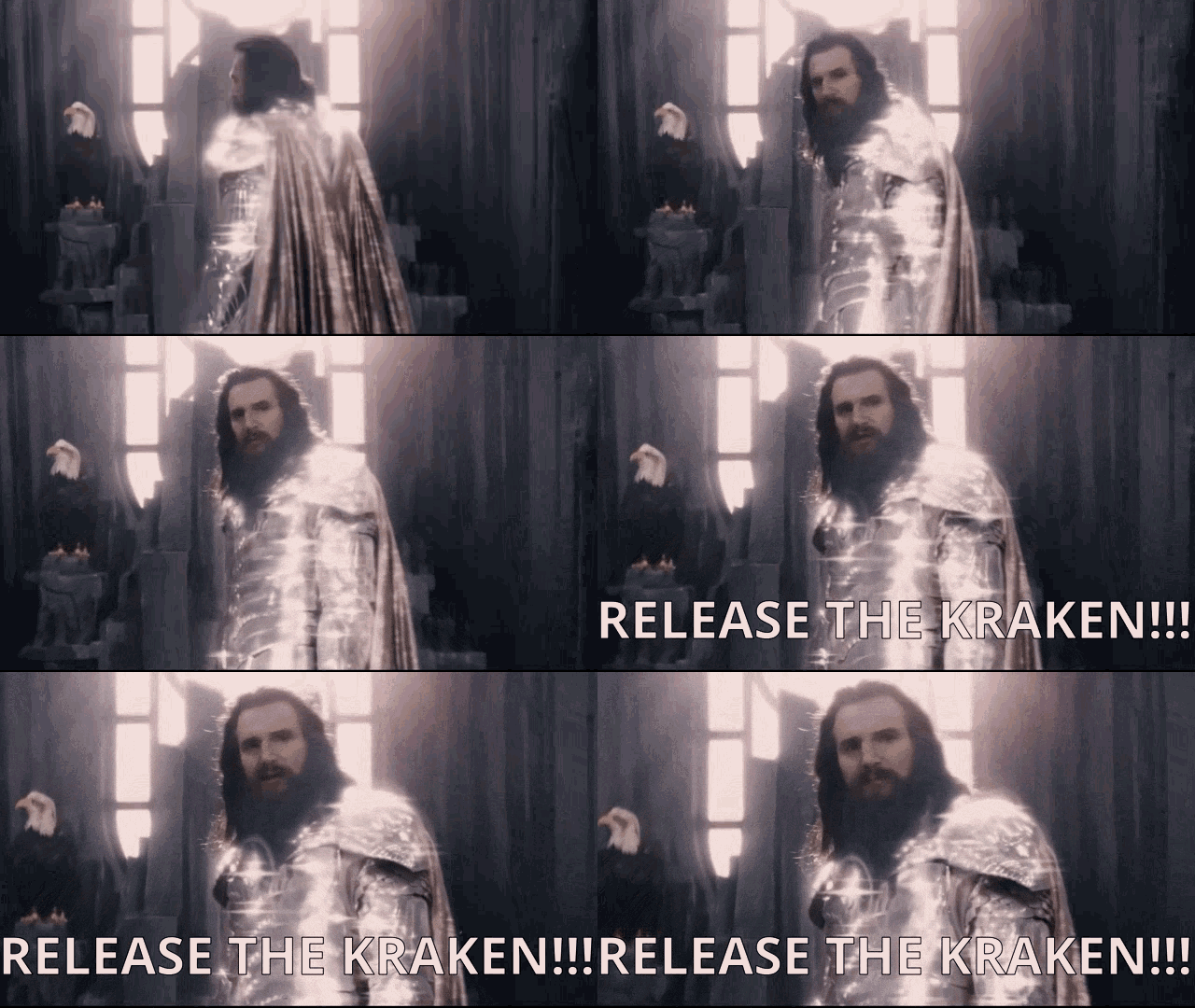
Perhaps narcissistically, I was expecting an opening discussion about Tennyson and the cosmic and was surprised by how Holmes opens his argument: with an 1830 poem that read, to me the scientist, as about science fiction, not science fact, “The Kraken.” If you’re anything like me, the first thing that comes to mind when you hear that title is the Greek god Zeus (Liam Neeson) in the 2010 film Clash of the Titans shouting, “RELEASE THE KRAKEN!” Which is to say, this is the stuff of mythology, not the stuff of science.
Plus, the poem’s opening lines don’t exactly sell a modern reader on the idea that there’s any science involved:
Below the thunders of the upper deep;
Far, far beneath in the abysmal sea,
His ancient, dreamless, uninvaded sleep
The Kraken sleepeth: faintest sunlights flee
These words are delightfully vivid and feel like Tennyson is painting with words — if you understand English from the Victorian era. It took me a couple of reads to fully appreciate these words are describing a creature in the calm ocean beneath the waves that can push ships on its surface to and fro. The word “abysmal” here works in two ways — “very bad” but also the more expansive secondary use, which is to have an apparently unending extension into the unknown.
If you read the lines aloud, you may find that you are carried along by a set rhythm in the words, the same iambic pentameter that Shakespeare used. Part of its beauty emerges from this cadence, which paints a vivid picture of a place most of us have never been, using a pattern that feels natural to the tongue and ear.
Over the years, this poem has been interpreted in various ways. But in the 1872 publication of his collected works, Tennyson made a note about this poem: “See the account which Erik Pontoppidan, the Norwegian bishop, born 1698, gives of the fabulous sea-monster – the Kraken.”
Which is to say, Tennyson’s inspiration was in part what at the time was established science writing, Pontoppidan’s apparently authoritative text on a sea monster that science would eventually come to appreciate has never, in fact, existed. Pontoppidan was wrong, but I understand now why Holmes is right to cling to this poem as evidence of the way that young Tennyson made science part of his literary universe. The history of science is littered with ideas that eventually went out of fashion but had cultural impact during their time in the spotlight.
During my vacation, I struggled my way through “The Kraken” and the claims Holmes made about it as I processed my feelings about cuts and changes to American, UK, and Irish basic science. In each country, there is a recurring theme: the withdrawal of support from basic science in favor of industry favorites like AI and quantum computing.
Could something like “The Kraken” come to be in a world where scientific curiosity is confined in the ways those in charge seek to limit it? I invite you to read “The Kraken,” which is at turns strange and beautiful, full of references to established “science” and the New Testament. Imagine a world where Pontoppidan never wrote about the Kraken, and Tennyson never riffed off his work in a poem that had real cultural staying power, and Liam Neeson never got to have one of the most memorable film lines of the 2010s. Maybe our lives would mostly be the same. But they would be a little less colorful. What important poem won’t get written because our governments are cutting basic science funding?
Thinking with Tennyson has been quite generative for me. My latest monthly column at New Scientist for subscribers (including library users!) is about the question of what happens when we ask the cosmos to create professional value for ourselves and when that becomes our primary motive for engaging with it. At its heart is an analysis of another Alfred Tennyson poem, “A Character,” which I’ll share here, as a reminder that the cosmos is an opening to ourselves, yes, but to witnessing the immensity beyond ourselves as well.
He spake of beauty: that the dull
Saw no divinity in grass,
Life in dead stones, or spirit in air;
Then looking as ’twere in a glass,
He smooth’d his chin and sleek’d his hair,
And said the earth was beautiful.He spake of virtue: not the gods
More purely, when they wish to charm
Pallas and Juno sitting by:
And with a sweeping of the arm,
And a lack-lustre dead-blue eye,
Devolved his rounded periods.Most delicately hour by hour
He canvass’d human mysteries,
And trod on silk, as if the winds
Blew his own praises in his eyes,
And stood aloof from other minds
In impotence of fancied power.With lips depress’d as he were meek,
Himself unto himself he sold:
Upon himself himself did feed:
Quiet, dispassionate, and cold,
And other than his form of creed,
With chisell'd features clear and sleek.

